I have fewer than 50 reviews. Will this work?
Yes. We start getting useful patterns at 5 to 10 reviews. Below that, the site leans more on photos, hours, location, and category data, so it still looks complete, just less review-driven. Above 50 reviews the JTBD analysis really kicks in. We don't try to manufacture a narrative out of thin signal, so a thin business gets a clean simpler page rather than fake confidence.
What about negative reviews?
We surface recurring themes carefully and down-rank one-off complaints. Isolated rants don't shape the site. If your overall rating is below 4 we warn you and ask if you want to continue. We never display your average rating publicly when it's below 4, even if you publish.
How are you sourcing the reviews?
Two sources, separated by purpose. The 5 reviews displayed verbatim on your generated site come from the official Google Places API (the licensed display surface). For analysis depth, we deep-pull up to 100 reviews per business through a licensed third-party data provider so the writer sees real patterns of named team members, repeat pain points, and voice phrases instead of guessing from a 5-review sample. The 100 reviews never appear verbatim on the site; they inform the writer. We use conservative attribution everywhere (first-name + last-initial + city, 18-word excerpt cap, no hotlinked Google avatars), which keeps published quotes in fair-use territory regardless of source.
Doesn't Google's API cap reviews at 5? How do you analyze 100?
Yes, the official Places API caps at 5 reviews per place. We are a direct API customer for that surface and respect the cap on what we display. For the deeper analysis layer we consume a third-party commercial data provider (DataForSEO) whose business model is built on aggregating this data legally for reuse. Industry precedent: Birdeye, Reputation.com, Podium, and ReviewTrackers all aggregate Google review data at scale through licensed providers. The legal framing is that the business owns the listing and authorizes review aggregation for its own site; we're operating in the same model. See our internal legal posture document for the detailed reasoning.
Where do the photos come from? Will they break a year from now?
We pull your photos from Google during generation, resize and convert them to WebP, and rehost them on our own CDN. Your site references the CDN copies, not Google's signed URLs. So no, they won't break if Google rotates their photo endpoint, and we don't leak our API key in any image src on your live site.
Does the site update when I get new reviews?
Right now, no. You can re-generate the site any time from your dashboard to pick up new reviews and photos, but it doesn't auto-refresh. Continuous updates are on the roadmap; we'll announce when it ships.
Multilingual? My customers leave reviews in Spanish.
If your reviews are in Spanish the site is in Spanish. If they're in German, German. We don't translate, because the customer's exact wording is the point. Multilingual is the default, not an add-on.
I'm a service-area business with no storefront. Will this work?
Yes. Most AI builders refuse service-area-only businesses, their FAQs literally say they need a physical location. Plumbers, electricians, mobile detailers, traveling notaries, in-home tutors, on-site contractors are all welcome. For trade verticals we generate per-city service-area pages (e.g. /locations/castle-rock) when you list 2+ cities served.
How does the site rank in local search?
Three layers: (1) multi-page architecture, each page targeting its own keyword cluster, so Google can rank each one for what it's actually about; (2) real schema chained by @id (LocalBusiness, Service, FAQPage, Review, Person) which AI Overviews and LLMs read when deciding who to cite; (3) Search Console submission baked in so Google indexes your pages instead of you waiting for them to be discovered.
Can I edit the generated content?
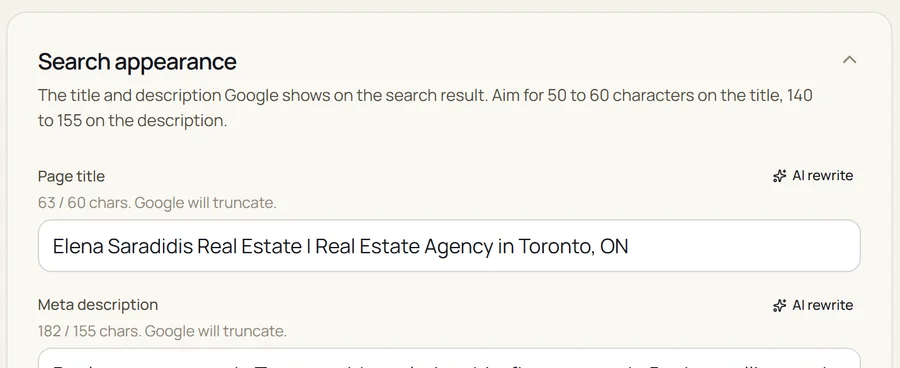
Yes. Every site has a per-section editor at /sites/[your-slug]/edit. You can change the meta title and description, the hero headline / subheadline / description, your trust signals, every FAQ question and answer, and your about page copy. Changes save independently and re-validate against our schema server-side, so a bad edit can't corrupt your site.
Can the redesign use my existing domain?
Yes. Domain connection and launch support are scoped as part of the managed redesign. We provide the exact DNS change, verify SSL and routing, and keep the preview private until the approved cutover.
What happens after launch?
Hosting, editing access, reporting, and ongoing optimization are agreed in the pilot scope before launch. We do not put a site live and then reveal a surprise self-serve tier or lock-in condition.
Is this live yet?
The generation and editing engine is live. Ask for your site and we build it first, free, then send you a private link with your new site beside your current one. It is $299/mo if you want it, with the $1,500 setup fee waived when you start within 7 days, and nothing is owed if you do not.
What about regulated industries (lawyers, healthcare, finance)?
We treat the safer-attribution rules as the default, not a paid upsell. Every site is built with first-name + last-initial + city attribution, 15-word excerpt cap, no hotlinked Google reviewer avatars, and proper Places API attribution. Some AI builders disclaim regulated industries entirely; we don't.
Do I own the site?
You own it. Hosting, domain control and editing access are included, and you can export the site's HTML and images at any time, including during the 30-day grace period after a cancellation. Looking at your built site commits you to nothing.
Why not dental practices?
Matt's day job is at The Dental SEO Company. Non-compete on dental, no dental clients on Rankary. Every other local service category is fair game: trades, medical-adjacent, beauty/wellness, legal, professional services, automotive, retail.